Brown Recluse Spider Bite: Symptoms, Stages, Treatment
You probably didn’t feel it. That’s actually the first clue that something unusual happened — most brown recluse bites go unnoticed at the moment they occur, and the pain takes hours to kick in.
Initial sensation: Often painless ·
Common symptoms: Redness, itchiness, pain ·
Complication risk: Necrosis in untreated cases ·
Onset of pain: 2–8 hours post-bite
Quick snapshot
- Bites often start painless (Healthline)
- Venom can cause hemolysis in 40.2% of cases (Healthline, 2020 study)
- Most bites heal fully within 3 months (Healthline)
- Exact frequency of severe necrotic cases in community settings
- Precise outcomes for pediatric and elderly patients
- Regional incidence data outside the US
- 0h: Painless puncture (Healthline)
- 3–8h: Stinging, redness develops (Cleveland Clinic)
- 3w: Thick black scab forms (Cleveland Clinic)
- Seek emergency care for fever, chills, nausea, or seizures (Healthline)
- Early curettage under local anesthesia resolves symptoms in 24–48 hours (PubMed)
- Mild bites typically heal without lasting damage (Healthline)
The following table summarizes key clinical attributes of brown recluse bites based on medical documentation.
| Attribute | Value |
|---|---|
| Typical first sign | Small red area (Cleveland Clinic) |
| Pain onset | Hours later (3–8 hours) (Healthline) |
| Severe outcome | Skin necrosis (Poison.org) |
| Fatal rate | Very rare (Poison.org) |
| Hemolysis rate | 40.2% of cases (2020 study) (Healthline) |
| Bite size limit | 2.5 inches maximum (Healthline) |
What are the first signs of a brown recluse bite?
The initial bite from a brown recluse spider is frequently painless — you might not realize anything happened until hours later. The small fangs and mild venom concentration mean the puncture itself causes little sensation at the moment of contact, according to Healthline’s medical overview.
Initial sensation
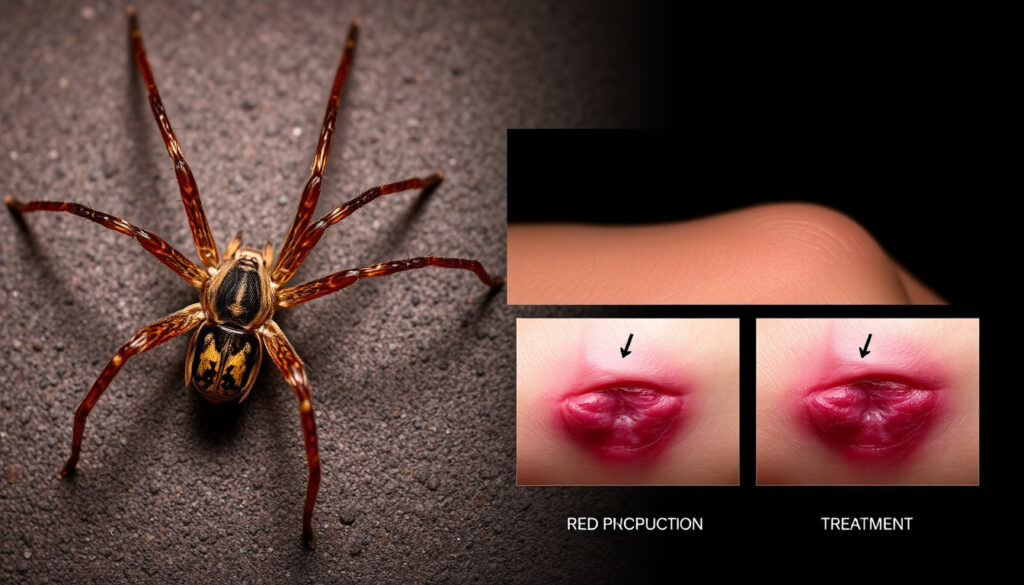
Within roughly 3 hours, a stinging sensation typically starts to develop. Cleveland Clinic notes that a sensitive red area, burning sensation, and sometimes a bullseye or bluish discoloration can appear within hours of the bite. Two tiny puncture holes with a pale center and inflamed outer ring may be visible early on.
Early redness and pain
A red or discolored tender area develops 4–8 hours after the bite, according to Healthline’s bite stage documentation. Swelling is typically minor unless the bite is on the face or feet. Most people experience itching and localized pain that intensifies as the venom begins its work.
The very mildness of the initial bite often leads people to dismiss it — a decision that can allow a treatable situation to develop into something more serious. Early recognition matters precisely because the early stage is when intervention makes the biggest difference.
What Does A Brown Recluse Bite Look Like?
Brown recluse bites typically present as flat, discolored areas that rarely exceed 2.5 inches in diameter. They usually lack the raised, puffy quality of many other insect bites, and they don’t typically produce pus in the early stages.
24 hours post-bite
Within the first 24 hours, fang marks, blister formation, swelling, and intensifying pain are common, according to Gopher Patrol’s documented progression. The blister may appear clear initially, then begin to change color as blood cells are affected by the venom.
4 days post-bite
By days 4–7, the bite area often darkens to blue or black as dead skin and open sores develop, Gopher Patrol’s stage documentation shows. The blister sinks and turns bluish-black over 12–48 hours per MedicineNet’s visual progression records. This color change signals necrosis — the venom destroying tissue at the bite site.
Later stages with blister
Ulceration may develop within 1–2 weeks in more severe cases. Week 3 typically brings a thick black scab, per Cleveland Clinic’s clinical guidance. Healing can take months, and a crater-like scar may remain.
In a 2020 study of 97 people bitten by the spider, 40.2% experienced hemolysis — red blood cell destruction caused by the venom. The discoloration you see isn’t just bruising; it’s the visible result of a biochemical process that can affect blood cells throughout the body in a significant minority of cases.
What is the treatment for a brown recluse spider bite?
There is no antidote for brown recluse venom — treatment focuses on managing symptoms, preventing infection, and minimizing tissue damage, according to Poison.org’s clinical guidelines.
Home care steps
- Clean the wound thoroughly with soap and water
- Apply a cold compress to reduce swelling and pain
- Elevate the affected area when possible
- Use over-the-counter pain relievers as needed
- Get a tetanus booster if your immunization status is unknown
When to seek medical help
Seek emergency care immediately if you experience chills, fever, nausea, vomiting, weakness, or seizures after a suspected bite, per Healthline’s warning signs. Difficulty sleeping, rash, or dizziness also warrant prompt evaluation.
Antibiotics role
Antibiotics may be prescribed to prevent secondary bacterial infection of the wound, particularly if ulceration develops. Poison.org’s treatment protocol notes that severe cases may require surgical intervention to remove necrotic tissue. Early curettage — scraping the wound under local anesthesia — resolves symptoms in 24–48 hours with minimal scarring, according to peer-reviewed research in PubMed.
The window for early intervention is real. If someone familiar with brown recluse bites sees the characteristic bullseye pattern within hours, curettage performed in those early stages can dramatically alter outcomes — transforming a months-long healing process into a 48-hour resolution with minimal tissue damage.
How can I identify a brown recluse?
The brown recluse spider (Loxosceles reclusa) has several distinctive features that set it apart from other common spiders in the United States. The violin-shaped marking on its back — the “fiddleback” name — is the most recognizable identifier, though this marking can be subtle on some specimens.
Physical features
- Uniform brown coloring, ranging from light tan to dark brown
- Six eyes arranged in three pairs — unlike most spiders with eight eyes
- No significant markings on the legs
- Body length typically 6–20 millimeters
- Leg span reaching up to 1.5 inches
Habitat clues
Brown recluses are most commonly found in the Midwest and South-central United States, according to eMedicineHealth’s regional analysis. They prefer dark, undisturbed spaces: closets, basements, storage boxes, and under furniture. They are rarely found in the wild outdoors and are not native to the UK or most of Europe. Outside the south-central US states, confirmed brown recluse populations are extremely rare.
Misidentification is remarkably common. Many harmless spiders are mistaken for brown recluses based on color or shape alone. The six-eye arrangement is the most reliable identifier — if you can clearly see the eyes, you’re probably looking at a different species. For confirmed identification, consider consulting an entomologist or sending a photo to your local cooperative extension service.
How serious is a brown recluse bite?
Most brown recluse bites heal without serious complications, but a minority develop into significant medical issues. The severity depends largely on the amount of venom injected, the location of the bite, and how quickly treatment begins.
Survival odds
Fatalities from brown recluse bites are extremely uncommon, per Poison.org’s clinical data. Most people recover fully within 3 months with appropriate care. Deaths are typically restricted to immunocompromised individuals, very young children, or cases where severe systemic complications were not recognized and treated promptly.
Complications like necrosis
The most feared complication is necrosis — tissue death at the bite site that can spread and require surgical removal, according to Prevention’s expert medical reporting. If the spider’s bite includes a large enough dose of hemotoxic venom, it can cause necrotic wounds or lesions that can take months to heal. Systemic symptoms including nausea, fever, and muscle pain occur in some cases when venom affects the bloodstream.
How to handle a suspected brown recluse bite
- Identify the bite site. Look for two small puncture marks, a pale center with a red ring, and a flat (not raised) appearance.
- Clean immediately. Wash the area with soap and water thoroughly within minutes of discovery.
- Apply cold. Use a cold pack or ice wrapped in cloth for 10–15 minutes at a time to reduce swelling and slow venom spread.
- Elevate if possible. If the bite is on an arm or leg, keep it elevated above heart level.
- Document the timeline. Note when you first noticed the bite and any symptoms, even if painless at first.
- Watch for escalation. If pain intensifies, blisters form, or any fever/chills develop within 24 hours, seek medical evaluation.
- Get checked if symptoms worsen. Emergency care for fever, nausea, weakness, or spreading discoloration. Tetanus update if needed.
Confirmed facts
- Bites often start painless due to small fangs (Healthline)
- Venom causes hemolysis in 40.2% of cases (Healthline)
- Blister turns bluish-black over 12–48 hours (MedicineNet)
- Ulceration may develop within 1–2 weeks (Healthline)
- Full healing typically takes up to 3 months (Healthline)
- Severe cases may require surgery (Poison.org)
- Fatalities are extremely rare (Poison.org)
What’s unclear
- Precise frequency of severe necrotic outcomes in community settings
- Exact pediatric and elderly case outcomes
- Global incidence data outside the US
- Antivenom efficacy trials remain limited
What experts say
We consider curettage the treatment of choice for brown recluse spider bites when the lesions are noted in relatively early stages.
— PubMed researchers, Peer-reviewed treatment study
If the spider’s bite includes a large enough dose of hemotoxic venom, it can cause necrotic wounds or lesions that can take months to heal.
— Health expert via Prevention
Most brown recluse bites are not serious and resolve on their own with proper wound care.
— Healthline medical editorial team
The practical takeaway for anyone in regions where brown recluses are established is straightforward: the painless opening act is a trap. By the time the stinging and redness announce themselves, the venom is already at work — and hours matter. Early recognition and prompt wound care transform most outcomes from months of healing and potential scarring into a manageable recovery. The rare severe cases that do develop necrosis or systemic symptoms respond best to medical intervention that happens within the first day or two, not the first week. Patients who act quickly on early warning signs consistently experience better outcomes than those who delay evaluation.
Related reading: Type 2 Diabetes Symptoms · Symptoms of Cervical Cancer
opcpest.com, moxieservices.com, columbiadoctors.org, resources.healthgrades.com
Frequently asked questions
Can you survive a bite from a brown recluse spider?
Yes, overwhelmingly so. Fatalities are extremely rare, and most people recover fully within weeks to months with proper wound care. Deaths typically occur only in cases with delayed treatment, immunocompromised individuals, or very young children.
Would you know immediately if you got bit by a brown recluse?
Most likely not. The bite is often painless at the moment it occurs, and many people don’t notice anything unusual until hours later when stinging, redness, or a blister begins to develop.
What does a brown recluse spider bite look like after 24 hours?
Within 24 hours, you typically see two small puncture marks, a flat red or discolored area that may have a bullseye pattern, and possibly a developing blister. Swelling and pain usually intensify during this window.
Do brown recluse spiders live in the UK?
No. Brown recluse spiders are native to the south-central United States. Confirmed populations in the UK or most of Europe are extremely rare. Most spider bites attributed to brown recluses outside that region are likely misidentified harmless species.
What is the most dangerous spider?
In the United States, the brown recluse and black widow are the most medically significant. Globally, Australian funnel-web spiders and Brazilian wandering spiders are considered more dangerous. However, spider bites overall are rarely life-threatening with modern medical care.
Are antibiotics needed for brown recluse bites?
Antibiotics are prescribed selectively to prevent secondary bacterial infection, particularly if ulceration develops. They are not routinely given for every bite. A medical professional determines whether antibiotics are appropriate based on the wound’s condition.
How long does a brown recluse bite take to heal?
Mild cases may heal within a few weeks, but most brown recluse bites take up to 3 months to fully resolve. Severe cases with significant necrosis can take longer and may require surgical intervention and scar management.
More related posts
 Tuni ian Football Champion hip Matche : Schedule & Live Score
 Michaela Conlin: Bones Cast Facts and Real Life
 Where Is Buck Martinez? Blue Jays Broadcaster Retires 2026
 Costco Price Adjustment Canada: Complete Guide (2025 Policy)
 Diane Ladd Cause of Death, Family, and Career Highlights
 Adam Scott: Actor or Golfer? Ethnicity, Net Worth & More
 Map of Israel and Palestine – Current Borders, Gaza and West Bank
 Conan O’Brien: Biography, Career, and Net Worth
