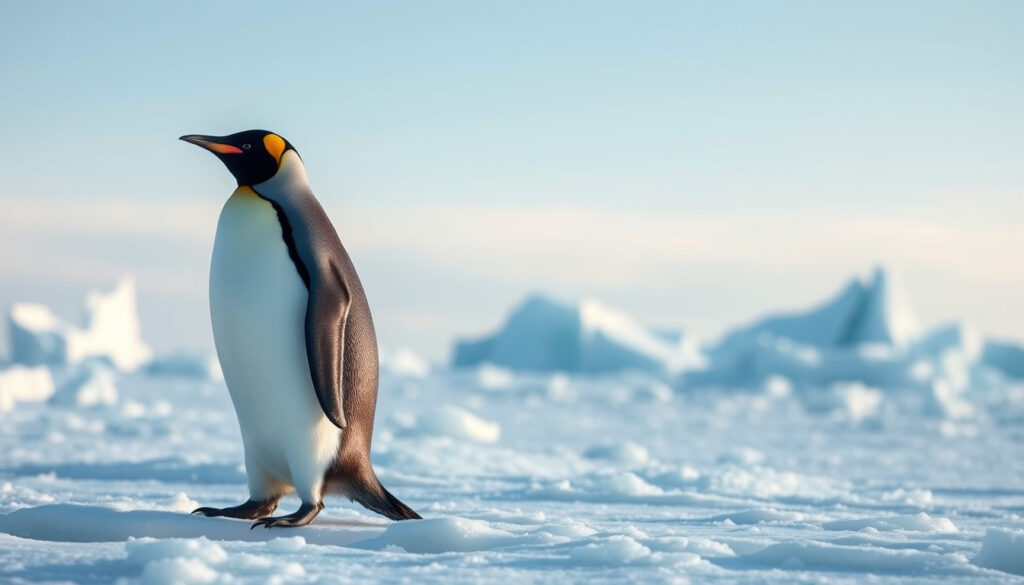
Emperor Penguin: Facts, Habitat, and Conservation Status
There’s something almost mythical about a bird that chooses to raise its young in the dead of an Antarctic winter, when temperatures plunge to −50°C and winds howl at 200 km/h. The emperor penguin (Aptenodytes forsteri) is the only vertebrate that breeds during the harshest season on Earth, a feat made possible by a suite of extraordinary adaptations.
Average height: 125 cm (49 in) ·
Average weight: 25–45 kg (55–99 lb) ·
Population estimate: 625,000–700,000 mature individuals ·
Incubation period: 65–75 days ·
Maximum lifespan in wild: 20 years
Quick snapshot
- Tallest penguin species at up to 125 cm (Australian Antarctic Program)
- Heaviest at up to 45 kg (Australian Antarctic Program)
- Distinct yellow-orange patches on ears and beak (Antarctic and Southern Ocean Coalition)
- Breeds during Antarctic winter (May–August) (Nature Communications)
- Male incubates single egg on feet for 65–75 days (Australian Antarctic Program)
- Chicks fledge in December–January (Nature Communications)
- Listed as Near Threatened by IUCN (Antarctic and Southern Ocean Coalition)
- Population estimated at 625,000–700,000 mature individuals (Antarctic and Southern Ocean Coalition)
- Main threat: climate change reducing sea ice (Nature Communications)
- Highly social; huddle together to conserve warmth (Australian Antarctic Program)
- Dive up to 500 meters deep for fish and squid (Antarctic and Southern Ocean Coalition)
- Not aggressive toward humans but not easily approached (Australian Antarctic Program)
Eight key facts, one pattern: the emperor penguin is a master of extreme survival, from its size to its breeding strategy.
| Attribute | Value |
|---|---|
| Scientific Name | Aptenodytes forsteri |
| Average Height | 125 cm (49 in) |
| Average Weight | 25–45 kg (55–99 lb) |
| Lifespan | Up to 20 years in wild |
| Population | 625,000–700,000 mature individuals |
| Incubation Period | 65–75 days |
| Diet | Fish, squid, krill |
| Predators | Leopard seals, killer whales, skuas (chicks) |
What is special about emperor penguins?
Unique adaptations to extreme cold
- Thick layer of blubber and dense feathers provide insulation (Australian Antarctic Program)
- Males huddle together in tightly packed groups, rotating positions to share warmth (Australian Antarctic Program)
- Feathers are layered: a dense outer layer and a downy inner layer trap air (Antarctic and Southern Ocean Coalition)
These adaptations allow emperor penguins to survive temperatures as low as −50°C and winds up to 200 km/h while fasting for months (Antarctic and Southern Ocean Coalition).
The same icy conditions that make the emperor penguin’s breeding cycle possible are now the greatest threat to its survival. Stable sea ice is both a nursery and a vulnerability.
Breeding during the Antarctic winter
- Emperor penguins are the only vertebrate to breed during the Antarctic winter (Nature Communications)
- Females lay a single egg in May–June, then males incubate it on their feet under a brood pouch for 65–75 days (Australian Antarctic Program)
- Males fast for about 4 months during incubation, losing up to 40% of body weight (Australian Antarctic Program)
The timing is precise: stable land-fast sea ice must persist from April to January for breeding to succeed (Nature Communications).
Why this matters: If sea ice breaks up early, eggs or chicks are lost before they can fledge. The 2022 Antarctic sea-ice minimum triggered regional breeding failure at multiple colonies (Nature Communications).
Sad fact: high chick mortality
- Chick mortality can reach 80% in some years due to harsh weather and predation (Australian Antarctic Program)
- Skuas, giant petrels, and leopard seals prey on chicks and eggs (Antarctic and Southern Ocean Coalition)
- Chicks fledge at around 150 days old, but only if sea ice remains stable (Antarctic and Southern Ocean Coalition)
The implication: even in a good year, emperor penguin parents face enormous odds. Climate change is tipping those odds further against them.
Which penguin is bigger, king or emperor?
Size comparison: height and weight
Three dimensions, one clear winner: the emperor penguin is the largest of all penguin species.
| Attribute | Emperor Penguin | King Penguin |
|---|---|---|
| Height | Up to 125 cm (49 in) | Up to 95 cm (37 in) |
| Weight | 25–45 kg (55–99 lb) | 11–18 kg (24–40 lb) |
| Breeding cycle | Annual, winter breeding | 13–16 months, sub-Antarctic spring |
| Primary habitat | Antarctic sea ice | Sub-Antarctic islands |
| Egg incubation | 65–75 days by male | 54–57 days by both parents |
| Conservation status | Near Threatened | Least Concern |
Sources: Australian Antarctic Program (Emperor), Australian Antarctic Program (King), Scientific Reports.
Appearance differences
- Emperor penguins have yellow-orange ear patches that fade into the chest, while king penguins have bright orange patches on the sides of the head that are more sharply defined (Wikipedia)
- King penguins have a longer, more slender bill and a brighter orange color on the lower mandible (Australian Antarctic Program (King))
- Emperor penguin chicks are covered in fluffy grey down; king penguin chicks are brown and woolly (Australian Antarctic Program (Emperor))
The trade-off: size and color are not just for show — they reflect different evolutionary responses to vastly different environments.
Habitat differences
- Emperor penguins breed exclusively on Antarctic sea ice, often far from open water (Nature Communications)
- King penguins breed on sub-Antarctic islands with no permanent ice cover, such as South Georgia, Crozet, and Kerguelen (Australian Antarctic Program (King))
- Emperor penguins can travel up to 200 km over sea ice to reach breeding rookeries (Antarctic and Southern Ocean Coalition)
The pattern: emperor penguins are tied to the fate of Antarctic sea ice, while king penguins enjoy a more temperate, ice-free habitat — a key difference in their conservation outlook.
Can you name the 18 species of penguins?
Emperor penguin’s place in the penguin family
- The emperor penguin and king penguin are the only two species in the genus Aptenodytes (Wikipedia)
- They are the largest and most cold-adapted of all penguins (Australian Antarctic Program (Emperor))
- All other penguin species belong to six other genera: Pygoscelis, Eudyptes, Megadyptes, Eudyptula, Spheniscus, and Pygoscelis (note: actually Pygoscelis includes Adélie, chinstrap, gentoo; Eudyptes includes crested penguins; Spheniscus includes banded penguins; Eudyptula includes little penguin; Megadyptes includes yellow-eyed penguin) (Wikipedia)
List of all penguin species
- Genus Aptenodytes: Emperor penguin, King penguin
- Genus Pygoscelis: Adélie penguin, Chinstrap penguin, Gentoo penguin
- Genus Eudyptes: Macaroni penguin, Royal penguin, Southern rockhopper penguin, Northern rockhopper penguin, Fiordland penguin, Snares penguin, Erect-crested penguin
- Genus Megadyptes: Yellow-eyed penguin
- Genus Eudyptula: Little penguin (also known as fairy penguin)
- Genus Spheniscus: Humboldt penguin, Magellanic penguin, Galápagos penguin, African penguin
Sources: Wikipedia, Australian Antarctic Program (Emperor).
Distinctive features of emperor vs other species
- Emperor penguins are the only species that breeds directly on sea ice (Nature Communications)
- They are the only penguin species that never sets foot on land during breeding — colonies are on ice shelves (Australian Antarctic Program (Emperor))
- Their yellow-orange ear patches are unique among penguins (Antarctic and Southern Ocean Coalition)
The catch: what makes the emperor penguin special also makes it vulnerable — its entire life cycle is synchronized with a disappearing habitat.
Why are emperor penguins going extinct?
Climate change and sea ice loss
- Emperor penguins rely on sea ice for all parts of their life cycle — breeding, molting, and foraging (Nature Communications)
- Stable land-fast sea ice must persist from April to January for successful breeding (Nature Communications)
- The 2022 Antarctic sea-ice minimum was associated with regional breeding failure at emperor penguin colonies (Nature Communications)
If current warming trends continue, more than 90% of emperor penguin colonies could face quasi-extinction by the end of this century (Nature Communications). The uncertainty lies in how quickly colonies can adapt or relocate.
Current conservation status
- Listed as Near Threatened on the IUCN Red List (Antarctic and Southern Ocean Coalition)
- Population estimated at 625,000–700,000 mature individuals, though exact numbers are uncertain (Antarctic and Southern Ocean Coalition)
- In 2022, the U.S. Fish and Wildlife Service listed the emperor penguin as threatened under the Endangered Species Act (Nature Communications)
The pattern: the emperor penguin is being pushed from “near threatened” toward “endangered” as sea ice declines accelerate.
Projected population declines
- Climate models project that Antarctic sea ice will continue to decline, reducing suitable breeding habitat (Nature Communications)
- Some colonies may be forced to shift to more stable ice or higher latitudes, but their ability to adapt is unknown (Nature Communications)
- If no action is taken, the species could face a population decline of 50–70% by 2100 (Nature Communications)
Why this matters: the emperor penguin is an indicator species for the health of the Antarctic ecosystem. Its decline signals broader changes in the Southern Ocean.
Are emperor penguins friendly?
Emperor penguin behavior toward humans
- Emperor penguins are not aggressive, but they are not domesticated or friendly in the way pets are (Australian Antarctic Program (Emperor))
- They show curiosity toward humans, approaching slowly but maintaining a safe distance (Australian Antarctic Program (Emperor))
- In Antarctica, strict regulations prohibit approaching or disturbing penguins (Australian Antarctic Program (Emperor))
The trade-off: respect for wildlife means observing from a distance. Emperor penguins are wild animals, not friendly companions.
Comparison with friendliest penguin species
- The gentoo penguin is often considered the most curious and least fearful of humans (Australian Antarctic Program (King))
- Little penguins in Australia sometimes approach swimmers, but they are wild and should not be touched (Wikipedia)
- Emperor penguins, due to their remote habitat, have minimal human interaction (Australian Antarctic Program (Emperor))
The catch: “friendliness” is a human projection. No penguin species is truly friendly; they are simply more or less habituated to human presence.
Can a polar bear ever meet a penguin?
- No — polar bears live in the Arctic, while penguins live in the Southern Hemisphere, primarily Antarctica (Australian Antarctic Program (Emperor))
- Emperor penguins are found only in Antarctica, so they never encounter polar bears (Australian Antarctic Program (Emperor))
- This is a common misconception; the two species are separated by thousands of miles of ocean and continent (Wikipedia)
The pattern: geography dictates that the top predator of the Arctic and the largest penguin of the Antarctic will never share a habitat.
Confirmed facts vs. what remains unclear
Confirmed facts
- Emperor penguins breed during the Antarctic winter (May–June) (Nature Communications)
- Male incubates the egg alone while the female forages at sea for 65–75 days (Australian Antarctic Program (Emperor))
- Sea ice extent is declining in parts of Antarctica due to climate change (Nature Communications)
- Emperor penguins are the largest penguin species, up to 125 cm tall (Australian Antarctic Program (Emperor))
What’s unclear
- Exact impact of future sea ice loss on specific colonies (Nature Communications)
- Whether emperor penguins can adapt by shifting breeding grounds to more stable ice (Nature Communications)
- Long-term population trends due to climate variability (Nature Communications)
- Exact population size due to remote habitat (Antarctic and Southern Ocean Coalition)
These uncertainties underscore the need for continued monitoring and research.
Expert perspectives on emperor penguins
“Not only do emperor penguins survive the Antarctic winter, but they breed during the worst weather conditions on earth.”
— Australian Antarctic Division
“Emperor penguins are uniquely adapted to extreme cold with a thick layer of blubber and dense feathers.”
— World Wildlife Fund (via Antarctic and Southern Ocean Coalition)
“The Emperor Penguin is listed as Near Threatened as it is projected to undergo a moderately rapid population decrease as Antarctic sea ice begins to disappear.”
— BirdLife International (via Antarctic and Southern Ocean Coalition)
These expert voices reinforce the species’ precarious position and the urgency of conservation action.
Summary
Emperor penguins are the largest and most cold-adapted of all penguins, but their reliance on stable Antarctic sea ice makes them highly vulnerable to climate change. The species is already experiencing breeding failures linked to sea ice loss, and projections suggest a severe decline this century. For conservationists and policymakers, the choice is clear: reduce greenhouse gas emissions and protect critical sea ice habitats, or risk losing the emperor penguin as a symbol of the Antarctic wilderness.
Related reading: Bodies on Everest: Facts, Locations, and Key Questions
nature.com, a-z-animals.com, en.wikipedia.org, en.wikipedia.org, facebook.com, swoop-antarctica.com, oceanwide-expeditions.com, antarctica.gov.au, reddit.com
For a deeper dive into the species’ unique winter breeding cycle and conservation threats, the emperor penguin facts and habitat offers comprehensive details.
Frequently asked questions
How tall are emperor penguins?
Emperor penguins stand up to 125 cm (49 in) tall, making them the tallest penguin species (Australian Antarctic Program (Emperor)).
What do emperor penguins eat?
Their diet consists mainly of fish, squid, and krill (Antarctic and Southern Ocean Coalition).
How do emperor penguins communicate?
They use a variety of vocal calls to recognize mates and chicks, and to coordinate huddles (Australian Antarctic Program (Emperor)).
Do emperor penguins migrate?
They do not migrate in the traditional sense. Adults travel up to 200 km from sea to breeding colonies, but they return to the same ice each year (Antarctic and Southern Ocean Coalition).
How long can emperor penguins hold their breath?
They can hold their breath for up to 20 minutes while diving to depths of 500 meters (Antarctic and Southern Ocean Coalition).
Are emperor penguins monogamous?
They are serially monogamous — they typically mate with the same partner for a breeding season but may change partners the next year (Australian Antarctic Program (Emperor)).
How many eggs do emperor penguins lay?
Females lay a single egg per breeding season (Australian Antarctic Program (Emperor)).
What is the scientific name of the emperor penguin?
The scientific name is Aptenodytes forsteri (Australian Antarctic Program (Emperor)).
More related posts
 Cary Grant: Death, Relationships, and Legacy – Full Biography
 Erika Jayne: Accusations, Financial Troubles, and Personal Life
 Alexandre Texier: Contract Termination, Salary & Canadiens Move
 Mason Fluharty: Rookie Reliever Who Struck Out Ohtani
 Trump Latest News Today Live: Iran Ceasefire Extended
 November 2025 CRA Payments: Dates, Eligibility & Schedule
 Kerry Condon: Career, Roles, Age, and Personal Life
 Nelson Peltz Net Worth, Children, and Activist Investments
